

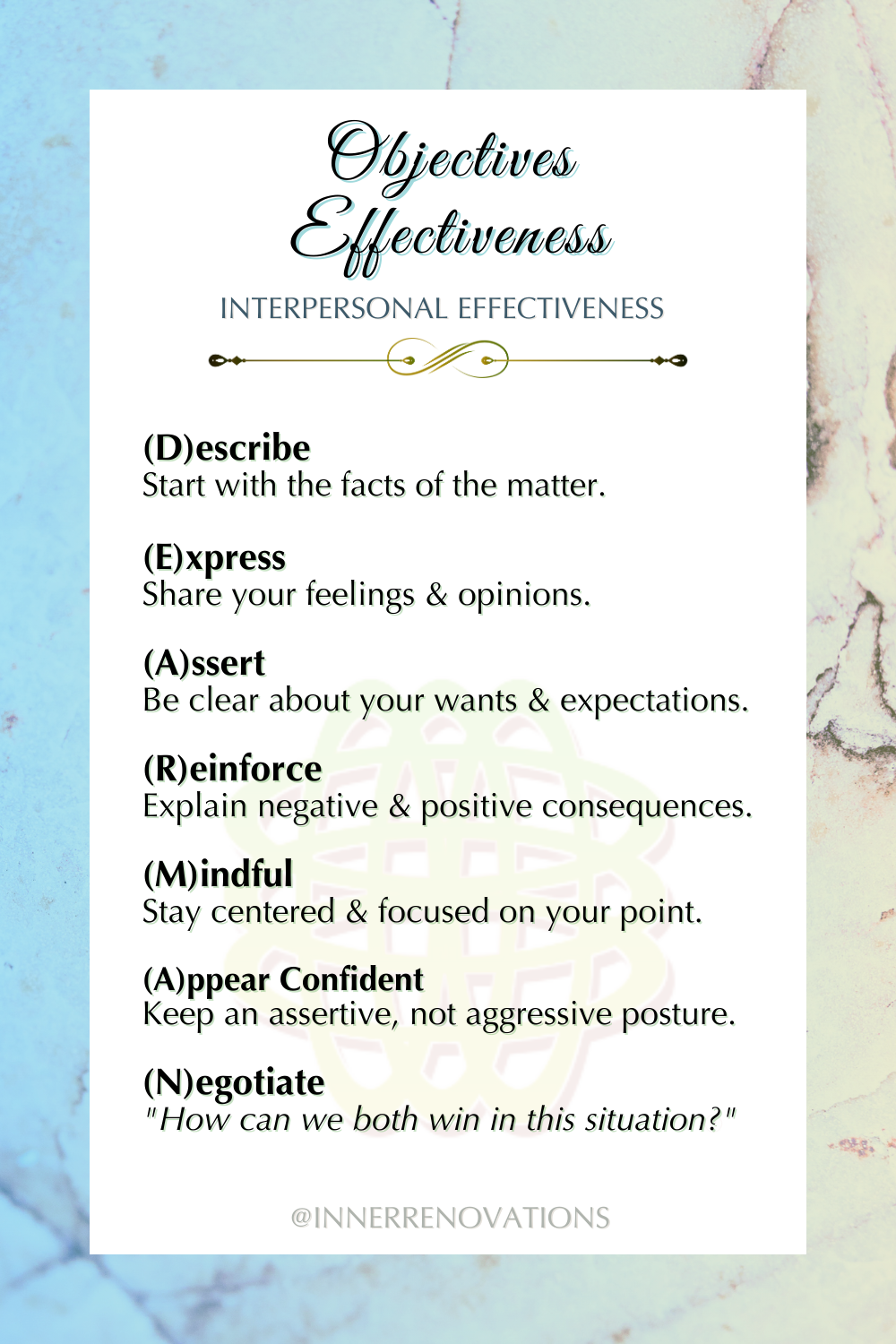
When navigating difficult conversations, it helps to have interpersonal effectiveness and communication skills. The following skill is used when we are trying to reach objectives such as as: get others to take us seriously, understand the importance of what we know/think/feel, when we need to be heard, and are setting boundaries and expectations. A way to remember these skills is to use the acronym DEAR MAN.
(D) DESCRIBE
Describe exactly what you are here to address and/or what you are responding to using FACTS only. This starts you off in a place where there is not a lot of room for argument. Facts are facts, and are not debatable: “This is what happened, and this is what I’m here to discuss.”
(E) EXPRESS
Now express your FEELINGS and OPINIONS about the facts of the situation. How did it make you feel? What is your opinion about it?
(A) ASSERT
Assert what you want and need. What are you hoping to get out of this discussion? This identifies the point of the conversation so that it leads to somewhere productive. Being assertive is NOT being aggressive. State your wants and needs with respect; being clear using “I want” and “I need” statements so the other person has no confusion about what you are trying to accomplish with them.
(R) REINFORCE
Reinforce your point. Tell the person the negative and positive consequences of getting what you want or need. Help the person feel good ahead of time for doing or accepting what you want (i.e., let them know how it can also work in their favor, and how it would help mend things between you). Reward them afterwards (a reward can be as simple as a hug, smile, showing appreciation).
(M) MINDFUL
Keep your focus on your objectives. Stay mindful of your boundaries. Don’t be distracted. Keep asking, or if necessary, keep saying no. Mindfully (not defiantly) maintain your position. Ignore if the other person employs tactics of guilt, manipulation, intimidation, or tries to deflect or change the subject (to the degree that you can keep yourself safe. Use mindful awareness to determine if you should remove yourself from the situation if ever you feel in danger). Stay mindful of your right to make your point, keep yourself safe, and act within the best interest of your mental health and wellness.
(A) APPEAR CONFIDENT
Show up in the moment as confident, competent, and effective. DON’T take the stance of victim. Use a clear and confident tone that both gives and is worthy of respect. Make good eye contact, no retreating or acting as if you don’t know what you want and need. Allow your posture to match the assurance with which you are speaking.
(N) NEGOTIATE
Be willing to GIVE to GET. Offer and ask for alternative solutions to the problem. Shift into partners speaking rather than opponent arguing. Focus on effectiveness, on what will work. Ask, “How can we both win in this situation?” Find the middle ground.
Reference: Linehan, M.M. (2015). DBT Skills Training Manual (2nd ed.). Guilford Press.
 Inner Renovations Toolbox