

DIALECTICAL THINKING is at the foundation of Dialectical Behavior Therapy (DBT) Skills Training.
DIALECTICAL THINKING is about being open-minded. It helps us navigate stressful situations, enhances our mental well-being, and improves our relationships with ourselves and others.
In essence, “Dialectics” can be described as a systematic approach to examining contradictory ideas in order to find harmony, resolve conflicts, and consider opposing viewpoints to uncover the truth.
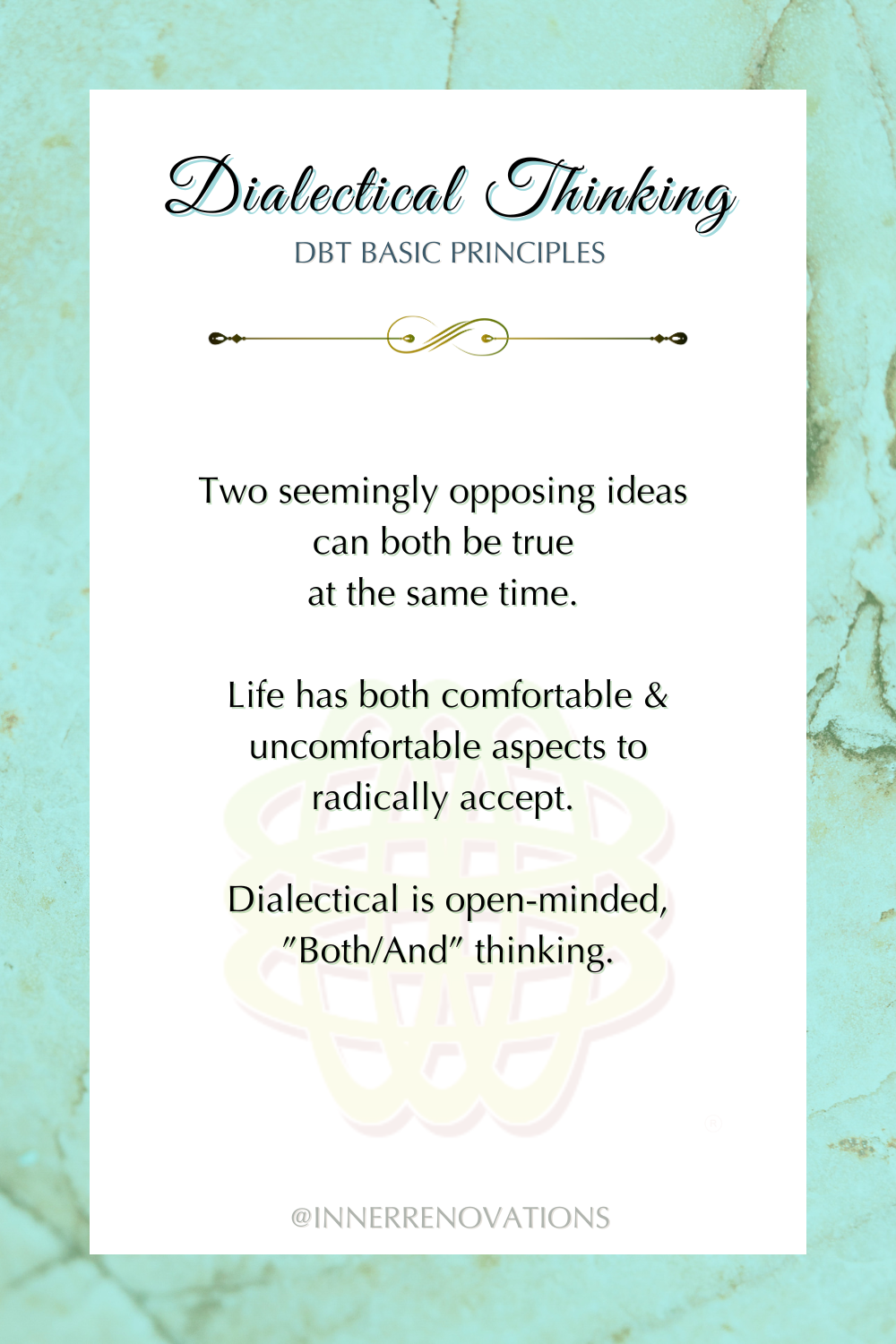
DIALECTICAL MEANS:
- Two ideas can both be true simultaneously.
- There can be more than one valid perspective or opinion.
- Two seemingly opposite things can both be true.
- Every person we interact with has something important and unique to teach us.
A Life Worth Living encompasses both comfort and discomfort (such as happiness and sadness, anger and peace, hope and discouragement, success and disappointment, fear and faith, and so on).
Consider these examples of dialectical statements:
- You are right, and the other person is also right.
- You are doing your best, and you can strive to do better, be more motivated, and embrace change.
- You can take care of yourself, and you can also seek help and support from others.
Are you ready to embrace a more dialectical approach? This means:
- Letting go of self-righteous indignation.
- Moving away from “black and white” and “all or nothing” thinking.
- Searching for what you may have missed in your understanding of situations.
- Validating both your own and others’ points of view.
- Expanding your perspective.
- Resolving standoffs and conflicts as best as you can.
- Balancing firmness and flexibility, approachability and healthy boundaries.
- Avoiding assumptions and blame, both towards yourself and others.
APPLY THE SKILL:
Take a moment to reflect on the situations in your life that are currently or have recently caused tension. Now, envision approaching them from a more Dialectical standpoint. What would that look like? How could it potentially shift your experience – thoughts, feelings, and behaviors? How might things change as you continue to embrace a Dialectical mindset?
Reference: Linehan, M.M. (2015). DBT Skills Training Manual (2nd ed.). Guilford Press.
 Inner Renovations Toolbox